
Department of Indigenous Studies
The World Council of Indigenous Peoples define Indigenous peoples as "people, living in countries which have populations composed of differing ethnic or racial groups, who are descendants of the earliest populations living in the area and who do not as a group control the national government of the countries within which they live."
Indigenous Studies at the University of Lethbridge is dedicated to community-engaged scholarship, and research of the priorities and aspirations of Indigenous peoples in Canada and throughout the world. Within the department, Indigenous and non-Indigenous students have the opportunity to learn and think about Indigenous knowledges in creative, transformative and critical ways. The department offers courses that engender a rigorous and respectful understanding of Indigenous peoples’ languages, knowledges, cultures, histories, politics, arts, intellectual traditions, and research methodologies.
Department of Indigenous Studies 50th Anniversary
Department Highlights

Summer Book Club:
Preparing for spooky season?
Join us in discussion of Indigenous scary stories from Alex Soop's Whistle at Night and They Will Come.
Everyone is welcome, bring a friend!
Where: University of Lethbridge Hall - Iikaisskini Gathering Centre (W650)
When: Wednesday August 5th from 4:00pm - 6:00pm & Tuesday August 11th from 4:00pm - 6:00pm
Snacks provided by Good Medicine Stories Research Project!

Finding their words again - University of Lethbridge researchers work to preserve and revive the endangered Blackfoot language
The SSHRC recently interviewed Dr. Inge Genee & Annabelle Chatsis on their efforts in Blackfoot language preservation and revitalization through research, education and community partnerships.
To learn more and read the interview follow the link below.
Additionally SSHRC will be promoting the interview on their social media accounts:

Congratulations Jocelyn McKnight on her much-deserved Meeting of the Minds win!
We are pleased to celebrate Jocelyn McKnight’s success at the Meetings of the Minds conference, where she received awards in both the poster and oral presentation categories for undergraduate students. Jocelyn’s work is notably interdisciplinary, bringing together ideas from Linguistics, Digital Humanities, and Indigenous Studies.
Jocelyn tied for first place in the poster competition for her honour’s thesis project, supervised by Dr. Conor Snoek in the Department of Indigenous Studies. Her research explores Tok Pisin, a lingua franca and mixed English and Indigenous language. Using a cognitive linguistic framework, she examines war and violence vocabulary in Tok Pisin and argues that its polysemous extensions can be understood through metaphor and metonymy.
In addition, Jocelyn placed second in the undergraduate oral presentation competition for a presentation on conceptual metaphor theory for love in Taylor Swift songs. This project originated as a paper for Dr. Snoek’s Language, Culture, and Cognition course in Fall 2025.
Abstract: Poster
'Let's Fight the Drums Because the Moon Is Fighting Me':
Polysemic Extensions of War and Violence in a Corpus of Tok Pisin
Catalyzed by an early history of forced displacement of Melanesian people, Tok Pisin has flourished into a stable language of mixed origins in Papua New Guinea. This paper presents a semantic analysis of Tok Pisin vocabulary associated with war and violence, while focusing on how these lexemes have undergone polysemic meaning extensions. The study is conducted on the Slone Corpus (Slone 2001), comprised of 873,347 tokens, containing Tok Pisin folktales from 1972–1997 in WantokNiuspepa and compared with dictionary data from the Mihalic dictionary (1971).
Ol i paitim han .
pl pm hit-tr hands
‘They clap their hands.’
Em paitim het bilong em.
3sg hit-tr head poss 3sg
‘He struck his head.’
The methodology combines three approaches. The first is etymological tracing for languages of mixed origin; this is adopted from Mühlhäusler (1984) to reconstruct the diachronic development of lexemes, and accounts for phonological, semantic, and structural blending. The second approach is semantic analysis grounded in Cognitive Linguistics to classify changes and identify how polysemic extensions emerge through conceptual associations; specifically, this paper examines metonymy (Ruiz de Mendoza 2000) e.g., striking action for rhythmic activity as seen in example (1) and (3), and metaphor (Lakoff & Johnson 1980) e.g., argument is war as seen in example (4). The third approach is corpus linguistics, which is used for textual processing.
Ol manmeri ol i paitim kundu.
pl people pl hit-tr drum
‘The people beat the drum.’
Bikpela kukurai i bin paitim toktok.
big meeting pm pst fight-tr talk
‘The big meeting argued.’
Ultimately, this paper contributes to etymological studies for contact languages and cognitive semantics by modelling how lexical meaning develops, stabilizes and grows within a mixed language. Learn more at https://doi.org/10.5281/zenodo.19102360.
Abstract: Oral Presentation
Understanding the Death of Love:
Conceptual Metaphors in Taylor Swift’s The Tortured Poets Department: The Anthology
This paper presents a cognitive linguistics study on the conceptual metaphors present in Taylor Swift’s 11th studio album, The Tortured Poets Department: The Anthology (TTPDTA). This album is the extended version of The Tortured Poets Department (TTPD) and contains 15 tracks in addition to the original release. For this study, 26 of the 31 songs from TTPDTA have been taken as a corpus to analyse the conceptual metaphors for romantic love used across the album. Metaphor Identification Procedure (MIP) is the primary qualitative methodology used, as it has been successful in previous studies of conceptual metaphor analysis for songs. This method consists of initial close reading, lexical unit identification, and contextual vs. basic meanings identification. Building off Lakoff and Johnson’s conceptual metaphor theory, this paper identifies key structural metaphors for love and relationships. The results suggest love is predominantly constructed through seven main metaphors (e.g., love is pain, love is prison, love is religion, love is a journey, love is a living organism, love is performance, love is game). This indicates that there is a small subset of recurring metaphors, all with stable entailments, that structure the way love and relationships are talked about and understood in this album, meaning they function as an album-level framing device. This paper contributes to the study of conceptual metaphors in music and the growing body of literature on metaphorical analysis in Taylor Swift songs, while laying the basis for future diachronic comparison of metaphors across Swift’s discography. Learn more at https://doi.org/10.5281/zenodo.19152651.

Congratulations Daniela McGonigal-Plankey on making 2nd place in the Meeting of Minds Graduate Presentation competition.
First a finalist for the 2026 3MT and now this! For her first big win for the Meeting of the Minds conference, 2nd place is still a fantastic recognition for her hard work as a graduate student. She should be proud to represent the Indigenous Studies department in this celebration.
Daniela tied for second place in the Master’s oral presentation category for her thesis work, supervised by Dr. Conor Snoek in the Department of Indigenous Studies. Her research focuses on the Mapudungun language of Chile, and she is studying how Mapudungun is taught online. Her research also explores how the signs and symbolic elements in the online videos being analyzed create an engaging learning experience for someone learning Mapudungun. Using the methodology of Thematic Analysis, she creates codes from the raw data being analyzed to find common patterns to answer her research question on how Mapudungun is taught online, and how modern technology like YouTube can create an engaging learning experience to learn an Indigenous language like Mapudungun.
Meeting of the Minds is a space for graduate students across all research disciplines to share their research and exchange ideas in a meaningful dialogue. It reflects the strength and diversity of graduate research at the University of Lethbridge through poster and oral presentations, and if reflects the dedication of each graduate student who pursues this opportunity. The conference celebrated their 20th anniversary this past Saturday, with a wide range of graduate and undergraduate student presentations. Daniela presented on a similar topic as a finalist for the 3MT, delving deeper into her methodology and the results she has found in her research.
Abstract: How Mapudungun is taught online
My thesis examines how Mapudungun is taught online, and how online platforms can effectively be used by a wider, global audience to learn an Indigenous language like Mapudungun. Data will be collected through the qualitative research method of Thematic Analysis with the objective of examining how Mapudungun is taught online. The significance of this research lies in the importance of Indigenous language maintenance in Latin America, and future efforts in revitalization efforts using a digital technology like YouTube.
Early results have shown an intent to bring Mapudungun to a wider, global audience, while focusing on Chile and Argentina. There is a relatability among young white Hispanic Chileans through the presence of a Hispanic Chilean learner, along with the cognitive model of “transfer error” and the assumptions held by the instructors that Spanish speakers inherently know English as a reference and have an established knowledge of English while viewing the videos. I examine the idea of exposure to a second language being taught in schools in Chile because of growing globalization and a push to learn English around the world. Another important aspect of my research is the idea of Connectivist theory, and the network of connections people create through the comments sections on the YouTube videos I am analysing. Is there a connection that can be created between language learners and engagement with Mapudungun through people’s public YouTube comments? This will shed further light on how an Indigenous language can be taught in the age of technology.
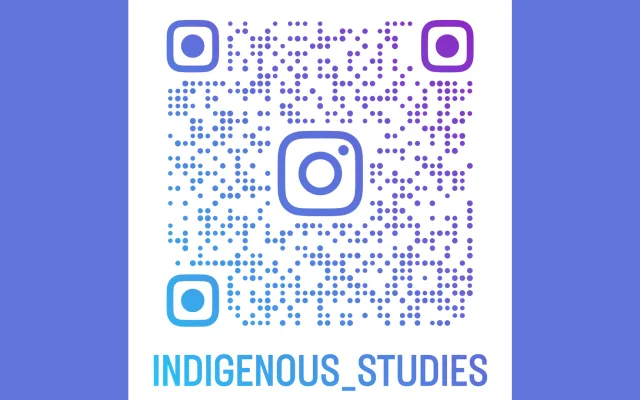
New Indigenous Studies Instagram Account
Keep up-to date on events and other happenings in the Indigenous Studies department by following our Instagram Account.

Shining Student Niihtaapookaa (Old Man River Child) Tatiana Weasel Moccasin
At the University of Lethbridge, Niihtaapookaa (Old Man River Child), Tatiana Weasel Moccasin has worked as a research assistant, travelled to Mexico for school, and embraced opportunities to enhance her creativity through creative writing and Indigenous art courses. Her future aspirations include becoming a teacher in Indigenous studies and language arts while continuing to advocate for Indigenous voices in education.
"I have so many great experiences here at the University. I loved the friends I've made, the club I joined (All My Relations) and the amazing professors I've been honoured to work with."

Shining Student Sii'piapaikkana (Night Shining) Dakota Wadsworth
Sii'piapaikkana (Night Shining), Dakota Wadsworth's (ISSC '24) time at the University of Lethbridge is a powerful testament to resilience, determination, and the strength of community. As a proud First Nations student and single mother, she has overcome financial barriers and personal challenges to excel in her studies, all while being inspired by, and inspiring those around her. Her story as a shining example of breaking through barriers to achieve dreams and create a brighter future.
"I used to be so scared to come to the University. But when I got here, I met some professors who were kind, encouraging, and truly there to assist when they could."
Remarkable young scholars to lead Raising Spirit in Blackfoot Territory 3.0
For more than 15 years, the Raising Spirit Project has brought together Blackfoot families, Elders, students and researchers at the University of Lethbridge to explore knowledge sharing, culture and community-based learning. Designed …
Read more
Southern Alberta Medical Program gifted Blackfoot names
From left, Shanda Webber, Dr. Leroy Little Bear, Dr. Esther Tailfeathers, Liz Piquette, Reuben Big Sorrell Horse, Dr. Amy Bromley,Dr. Francis First Charger, Dr. Aaron Johnston, Dr. Sam DeWalle, Kelly Dinsmore, Janessa …
Read more
Blackfoot artist Zoe Buckskin to be featured at Vibe Fest, Abbondànza 2026
Vibe Fest and Abbondànza explore the full spectrum of emerging art practices across disciplines. Learn more about the 2026 event's featured artist, Zoe Buckskin.
Read more
Future Students Apply Now!
Image
Put Your Knowledge to Work
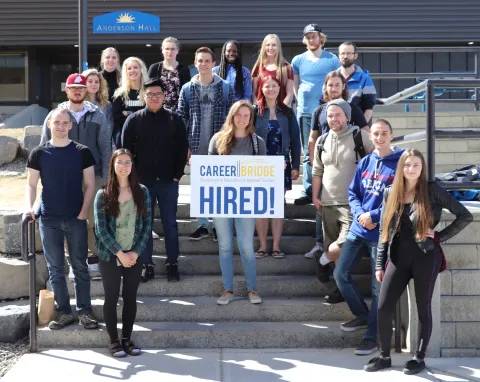
Whether you’re looking for a more in-depth learning experience by assisting with research projects on campus or by testing your knowledge in a real-life work setting, we can help! ULethbridge is proud to offer you an exceptional opportunity to explore professional development through academic programs and services designed to give you a competitive edge in a fast-changing world.
You have a bright future — experience it via Career Bridge at ULethbridge!